
Kansas City Star-Times, July 9, 1947, p.1
(retrieved 2026 from Newspapers.com)
DISKS ARE THEIR JOB
------------
Members of Fairfax Radar Unit Launch Them to Measure Wind.
----------------
NEW DISK CLUE A DUD
The flying disk found Monday [July 7] near Adrian, MO., is a reflector which had been sent out by an army radar bomb scoring unit at Fairfax field. [Kansas City, MO]
Lieut. Roger E. Cuddeback explained yesterday that the tinfoil-covered triangular box was part of the unit’s equipment, sent out on balloons. Two reflectors a day leave Fairfax field and usually ascend to about 100,000 feet before the balloon breaks. Then the silvery box falls to the ground.
When he reflectors are released, one at 10 o’clock in the morning and one at 3 o’clock in the afternoon, they are “tracked” with radar equipment to make wind measurements. The reports are sent to the weather bureau as a double check of its measurements.
The balloon released at 3 o’clock yesterday was about eight feet in diameter. On a 10-foot lenth of cord dangled the target, a concentric arrangement of triangles which presented a broad tinfoil-faced side no matter which way it turned.
Filled with hydrogen (it’s cheaper than helium), the balloon ascended rapidly and almost vertically above the radar bomb scoring station behind the T.W.A. overhaul base at the field. The antenna atop the radar trailer quickly turned its beam fully on the target.
The target went up about 1,400 feet a minute and soon could not be seen. But the balloon, expanding as it hit lighter air, continued in sight for fifteen minutes. From it’s starting point it moved almost directly between the watchers and the sun, the light behind it giving it a brass-colored appearance. It was impossible to distinguish that it was a ball rather than a disk.
Personnel at the base unit are used to watching the balloons to a height of 40,000 feet without the aid of binoculars. The radar plotting room at the station can track targets a lateral distance of about twenty-five miles. Letters from persons finding the not-to-be-returned targets have come from much greater distances.
Lieutenant Cuddeback said that one balloon hit a 119-mile-an-hour wind at 25,000 feet when twenty miles from the airport. That was the fastest wind recorded at Fairfax. With such a velocity, he said a balloon might be carried hundreds of miles but never at 1,000 miles an hour. Other AAF detachments also make regular wind checks.
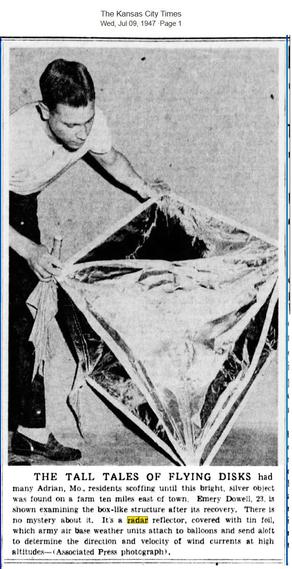
Photo Caption (Adrian MO rawin)
THE TALL TALES OF FLYING DISKS had many Adrian, Mo., residents scoffing until this bright, silver object was found on a farm ten miles east of town. Emery Dowell, 23 is shown examining the box-like structure after its recovery. There is no mystery about it. It’s a radar reflector, covered with tin foil, which army air base weather units attach to balloons and send aloft to determine the direction and velocity of wind currents at high altitudes—(Associated Press photograph)-
Adrian, Missouri, July 7, 1947
Butler (MO) Daily Democrat, July 9, 1947, p. 1
"FLYING DISK" FOUND NEAR ADRIAN, CAME FROM FAIRFAX
Bates County Democrat, Butler, Missouri, July 10, p. 1
EXCITEMENT ABOUT THE FLYING DISKS GROWS
Interest Grows in Bates County When Triangular Object is Found Ten Miles East of Adrian--It Came from Fairfax Field
The excitement over the "flying disks" at different point through-out the country has reached Bates County. A picture on the front page of Wednesday morning's [July 9] Kansas City Times showed Emery Dowell, age 23, a son of John Dowell, editor of the Adrian Journal, examining a silver object found on a farm 10 miles east of Adrian.
But there is no mystery about it, because it turned out to be a radar reflector, covered with tin foil, which army air base weather units attach to balloons and send aloft to determine the direction and velocity of wind currents at high altitudes.
According to the Times, the reflector picked up near Adrian was definitely from the army bomb scoring unit at Fairfax Field in Kansas City, Kansas.
Lieut. Roger E Cuddeback explained that the tinfoil-covered triangular box was part of the unit's equipment sent out on balloons. Two reflectors a day leave Fairfax Field and usually ascend to about 100,000 feet before the balloon breaks. Then the silvery box falls to the ground.
When the reflectors are released, one at 10 o'clock in the morning and one at 3 o'clock in the afternoon, they are "tracked" with radar equipment to make wind measurements. The reports are sent to the weather bureau as a double check of its measurements.
According to the Times, the excitement over seeing the "flying disks" has now reached England, where a rancher near London was reported to have seen one of the flying objects.
Butler, Missouri, The Republican Press, July 10, 1947, p. 1
WAS NOT A "DISK"
Grant Cook, residing west of Adrian, found an object in a field near his home Monday afternoon that was at first thought to be related to the flying disks that have been reported from so many points of the country. The object turned out to be a radar device used in determining the velocity of the wind at high altitudes.
The unusual contraption carried code letters and numbers which identified it as coming from the Fairfax air base in Kansas City, Kas., and an officer from the base was interviewed by the K. C. Star and gave the following information regarding them.
Two of the reflectors, attached to balloons, are released regularly each day, one at 10 o'clock in the morning, and the other at 3 in the afternoon. Radar equipment at the base follows the progress of the flight and by this means velocity of the wind at high altitudes is determined. the balloons usually ascend to a height of 100,000 feet before the balloon breaks and the reflector falls to the ground.
