Wilmington, Ohio Daily News-Journal, p. 2, July 10, 1947
“Flying Saucer” Reported Port William Is Radar Target
Port William became the first Clinton County community to have a report of a flying saucer Wednesday when Eugene Powers found one at his home in the village, but it turned out that was all part of a joke and that the “flying saucer” was an aerial radar target, probably used in connection with the Thunderstorm Project.
Although the Powers family was all at work when a News-Journal reporter L. M Dye, official in charge of the field operation center of the Weather Bureau phase of the Thunderstorm Project, visited Port William Thursday noon [July 10], men who had seen the object found by Powers at his home Wednesday [July 9] identified a picture of a radar target as the same object Powers had found.
Principles in the prank were not talking vet it was reliably reported, found by Wilton Liming on the Simon Devoe farm and that Liming and Irvin Ross put the target back of the Powers home with the intention of making them believe it was a flying saucer.”
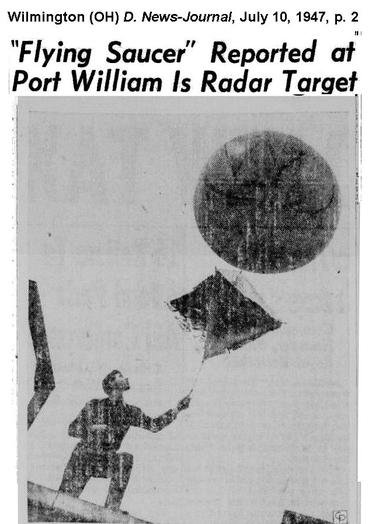
The object shown at the right about to be release is of the type found by Powers and is used in the Thunderstorm Project study.
Over 130 Released
Dye explained the from 130 to 140 of these targets had been released by the five SCR-584 radar stations set up by the Weather Bureau south of Wilmington for the study if thunderstorms. These targets are made of helium inflated balloons with an aluminum foil “kite” suspended beneath the balloon. Radar impulses are reflected are reflected by the “kite” and by tracking the tarfet, the SCR-584 station operators can tell the speed and direction of the wind in the thunderstorms.
After they fall, they are of no value to to the Weather Bureau, Dye said.
There also are seven SCR radar stations in the Weather Bureau network south of Wilmington which send up balloons with radiosonde transmitters swung beneath them that transmit weather information. When these balloons burst a parachute is opened to drop the transmitter to the ground.
He said there is a card on these transmitters requesting the finder to return them to the Weather Bureau as they are repaired and used again. Approximately 150 of these balloons and transmitters have been by the seven stations since the study of thunderstorms started in this vicinity, Dye said.
Dye would not hazard a guess on the explanation for the “flying saucers” but he was certain the chest found at Port William was not one.