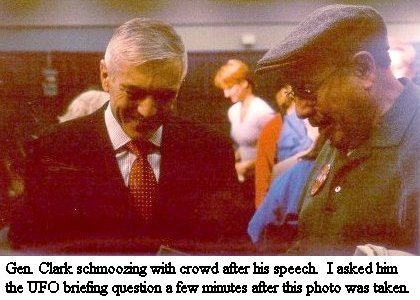
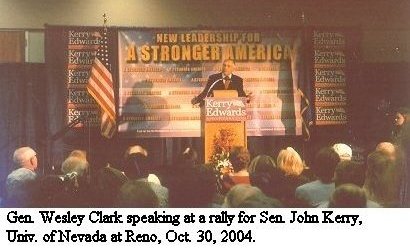
Q: Gen. Clark, when you were running for President, you said you thought mankind would one day fly faster than light and visit the stars. My question is, when you were in the military were you ever briefed on the subject of U.F.O.s?
At this point Clark looked down for a moment and shook his head, perhaps somewhat chagrined at being put on the spot or thinking how he should respond, but then looked at me and answered:
A: I heard a bit. In fact, I'm going to be in Roswell, New Mexico tonight.
Q: So you were briefed?
A: There are things going on. But we will have to work out our own mathematics.
In interpreting Clark's remarks, we have to realize that he was speaking in Washingtonian code on a touchy subject. He never directly admitted to receiving an official briefing, thus leaving himself a possible out. He could claim, e.g., that what he meant was he had heard the usual stories and rumors, just like everybody else.
But on the other hand, he never gave a simple, flat denial to the questions about being briefed, such as "No I wasn't." That would have put an end to it right there. Instead he dropped broad hints indicating that he was indeed briefed and that UFOs were real craft. Hence his comments about hearing a few things when he was in the military and "there are things going on."
Further, why talk about developing our own mathematics for something that was nonexistent? If you look back at Clark's FTL comments above, he likewise spoke of the need to explore higher and applied mathematics in order to eventually achieve FTL travel. In this respect, Clark's brief remarks to me were very similar to his FTL remarks a year before. My interpretation is that his FTL statements were indeed tied to the subject of UFOs.
Another broad hint was how he spontaneously brought up the subject of Roswell, N.M. immediately after saying he had heard some things.. Perhaps that was his oblique way of saying that the alleged Roswell flying saucer crash was one of those things that he had "heard a bit" about when he was in the military.
(According to fellow researcher Grant Cameron, Clark may have more than just heard about Roswell. Soon after I notified Cameron about what Clark said to me, he posed the question of Clark's UFO knowledge to NIDS, a Las Vegas-based UFO investigation group composed of a number of people having contact with government insiders, one of them told him that "Clark has been given access to crashed saucer material." Another source said that Clark "knows something about the crash retrieval." For more, see Cameron's web site and Linda Moulton Howe's Earthfiles, also discussing the Wesley Clark story. I had contacted Cameron immediately after returning from Reno and he then shared the information with Howe.
(Update 2023: Also seeherefor another more recent discussion of the Clark story and how Cameron's NIDS source was likely physicist Dr. Eric Davis. Davis is also the alleged creator of the Wilson-Davis memo, in which Adm. Thomas Wilson, as Director of the Defense Intelligence Agency, told Davis in 2002 that when he inquired into the crashed UFO retrieval and back-engineering program in 1997 he discovered it was real but couldn't get further access because control of it had been passed to private aerospace contractors such as Lockheed-Martin. The memo is now published on the Congressional website and is being treated as authentic. Davis has publicly admitted giving classified briefings on UFO crash retrievals in Oct. 2019 to staff members of the Senate Armed Services and Intelligence Committees (NY Times article) The memo was originally in the personal papers of Apollo 14 astronaut Dr. Edgar Mitchell and found after his death. Mitchell, who grew up in Roswell, also publicly stated on multiple occasions he was convinced from interviews with "old-timers" that the Roswell spacecraft crash was real.)
To understand the somewhat cryptic manner in which Clark responded, it is important to realize that he would only be briefed if the topic were treated with dead seriousness by the military. It would necessarily be classified at a very high level. Clark can't speak directly about what he might know without violating his security oath. Hence the care with which he tip-toed around the questions without actually denying anything.
Cameron asked Cheney whether he had ever been briefed about UFOs when he was in the government. To this Cheney replied, "Well, if I had been briefed on it, I'm sure it was probably classified and I couldn't talk about it."
Like Clark, Cheney talked around the question without giving an unqualified denial. Again the key to this, as Cameron points out, is Cheney mentioning how the subject matter would be classified, so that he couldn't talk about it if he had received such briefings.
Gen. Clark was in exactly the same position as Cheney, and I appreciate that he bothered to respond to my questions at all. Hopefully at some time in the future, Gen. Clark will tell us a little more about what he might know.
2008 Update: "I've never been briefed on Roswell."
"I emailed Ufologist Bill Hamilton about this [denial of briefing on Roswell]. He replied saying, 'He wasn't briefed on Roswell, but was briefed on faster-than-light spaceships that
we have in our underground space bases.'"
There are many possible ways to interpret Clark's remark. He flatly denied any briefing specifically about Roswell, though he was actually asked whether he had been briefed on UFOs in general, and did not directly answer this question, nor any other question put to him.
I also have my doubts about Bill Hamilton's comments. If Clark already knew that we had our own FTL craft, why would he make a public statement in 2003 saying he favored a massive research and development program to develop such craft?
My own current take on this remains that Clark did receive briefings on UFOs (which he again did not deny receiving). I would speculate that in such briefings, he was informed they had FTL capability and that we were attempting to back-engineer them from captured technology, though perhaps unsuccessfully so far. Knowing that FTL travel was indeed possible would explain why Clark would be willing to commit to his "faith-based" very expensive and lengthy R&D program, if elected President, in order to develop such technology. Furthermore, knowing in general about captured alien technology and back engineering attempts would tell him that Roswell was a real alien crash-recovery event, even if he wasn't specifically informed of this.
Another line of speculation is that a public R&D FTL program would enable future introduction of such technology, perhaps for commercial purposes, without having to admit to its ultimate origins, which might still be considered to be very socially disruptive.
Gen. Nathan Twining: Was USAF Chief of Staff 1953-1957 and Chair of the Joint Chiefs 1957-1960. In 1947 was head of the Air Materiel Command at Wright Field, home of the Air Force's aerospace R&D labs, and where Roswell crash material and bodies allegedly were taken. Made public comments on how the Air Force was seriously investigating UFOs.Suddenly canceled a scheduled trip to Boeing Aircraft and instead flew to New Mexico during the Roswell incident (July 7-11). Famous for a Sept. 1947 Secret UFO memo that affirmedUFO reality, UFOs being under intelligent control, and urged a back-engineering program involving top intelligence and government R&D agencies. In 1953, as AF C/S, issued Air Force Regulation 200-2 defining UFOs, saying they were to be studied for reasons of national security and their "technical aspects." His namesake son, Nathan Twining Jr., told several people privately that his father dodged talking about Roswell most of his life but finally made a death-bed confession that it was a spacecraft crash with several bodies recovered and one live alien which he frequently visited and communicated with telepathically. Was apparently also very upset about the number of planes and pilots lost intercepting UFOs. (I also heard the latter claim from Twining Jr. the one time I spoke with him on the phone. He said his father was offered a million dollars to write his memoirs after he retired but turned it down, considering it "blood money" for the men who had lost their lives during his command, including when they intercepted UFOs.)
Brig. Gen. Arthur Exon on Roswell being a crashed spacecraft, Roswell alien body recovery, alien materials testing at Wright-Patterson AFB, and other crash recoveries during his tenure as C/O of Wright-Patterson..
"Brig. Gen." Steven Lovekin (Disclosure Project witness) on Pentagon UFO briefings while in the Kennedy/Eisenhower White House, being shown alien crash materials from New Mexico, being told of alien bodies being recovered, and Eisenhower's concern over corporations seizing control of UFO information from the government (tied in with Eisenhower's famous "military/industrial complex speech"). Also said he was told by an older officer that people, even whole families, had been murdered to keep the secret. Testimony about corporations in control of UFO materials and serious crimes being committed in the name of security very similar to modern 2023 whistleblower intelligence officer David Grusch.
Brig. Gen. Thomas Dubose on the Roswell weather balloon coverup ordered from Washington to get the press off their backs; high security surrounding Roswell, and secret shipments of debris to Washington and Wright-Patterson. During the Roswell incident, Dubose was Gen. Roger Ramey's chief of staff and said he personally took the phone call ordering the coverup. In one unrecorded interview, allegedly confessed to alien bodies being recovered.
Gen. William Blanchard: Commanding officer of Roswell AAF in 1947 during the Roswell incident. Issued the infamous press release July 8, 1947, that the base had recovered a "flying disc." Rose to Vice Chief of Staff of the Air Force. According to researcher Robert Hastings in his book "UFOs and Nukes", nuclear engineer Chester Lytle(build first A-bomb implosion device) told him Blanchard in 1953 confessed that Roswell was indeed the crash of a spaceship and four dead alien bodies were recovered. The Lytle link also has statements by Major General Kenner F. Hertford, that he was almost completely convinced that Roswell was a real spacecraft crash and alien bodies were recovered. Hertford had had a UFO sighting with Lytle at Kirtland AFB near Albuquerque and knew him well from their joint work on atomic weapons.
Brig. Gen. Harry Cordes was stationed at Roswell in 1947 (then as a lieutenant). His widow, raised on a farm in the Roswell area, spoke of how her husband unsuccessfully tried to find the Roswell files when he worked with the CIA in the early 1950s, how their neighbors, Sheriff and Mrs. George Wilcox, had been threatened, how base commander Gen. William Blanchard was a "believer", knowing of mortician Glenn Dennis' nurse, how the base had cleaned out all the ice in town at the time, how machine-gun toting airmen kept out residents from the ranch areas, hearing of caravans of trucks heading back to the base, plus more. From Kevin Randle's blog spot.
Last updated on: May 5, 2024
General Wesley K. Clark on UFOs
In a short encounter, Gen. Clark drops some hints about UFO reality
by David Rudiak
Added November 3, 2004
Gen. Wesley K. Clark is a retired four-star Army general. At the peak of his career from 1997-2000 he was NATO Supreme Allied Commander in Europe and Commander-in-Chief, United States European Command.
He graduated first in his class from West Point in 1966 and was a Rhode's Scholar at Oxford University from 1966 to 1968. This only briefly touches on his educational and military background, but indicates he was one of the nation's top generals and one very sharp guy.
Most people, however, know Gen. Clark as a Democratic candidate for President in 2003-2004. During a campaign event Sept. 27, 2003, in New Castle, New Hampshire, before about 50 people, Clark stated his belief that humans will someday be able to travel faster than the speed of light (FTL travel), putting no limit on how far we will be able to explore in space.
Clark's remarks were prompted by a question from Dr. Jay Buckey, who was an astronaut on the space shuttle. He asked what Clark envisioned for America's space program after the Columbia shuttle tragedy. Clark said he was a great believer in the space program and wanted a vision well beyond that of a new shuttle or space plane. He hoped mankind would eventually leave this planet and explore space beyond the solar system. Clark thought such a vision could probably require a lifetime of research and development in various fields of science and technology. Then at the end of his remarks, Clark dropped a bombshell when he said the following:
"We need to look at the realms of applied and higher mathematics. I still believe in
E = mc squared. But I can't believe that in all of human history, we'll never ever be
able to go beyond the speed of light to reach where we want to go. I happen to
believe that mankind can do it. I've argued with physicists about it. I've argued with
best friends about it. I just have to believe it. It's my only faith-based initiative."
The mass media then mocked Clark for his remarks, claiming that Clark said he believed in "time travel." But Clark never said any such thing, only that he believed we would one day travel faster than light. [Check the audio (NEW) andtranscript.]
What was the basis of Clark's unusual belief, which flies in the face of conventional scientific wisdom? Some of us speculated that maybe Clark, as a top general, had been briefed on the subject of UFOs, knew them to be real extraterrestrial craft, and therefore already knew that FTL travel was very likely possible.
As luck would have it, I happened to be in Reno, Nevada on Oct. 30, 2004, at the same time that Clark was doing a campaign rally on behalf of John Kerry. That gave me the opportunity to briefly question Clark. After his speech, a small crowd gathered around Clark. Clark shook hands, posed for pictures, signed autographs, and spoke informally with various people.
Finally I got my chance to ask him about his FTL remarks and what prompted them. Unfortunately, I wasn't prepared for this and didn't have a recording device with me, but the following is very close to my questions and Clark's answers, which I wrote down from memory immediately afterwards:
June 30, 2021: "Who says we can't have a warp drive?"
I received another tip from Grant Cameron shortly before this update, in which he told me of a more recent interview with Clark that brought up the subject of UFOs and whether we had a "Star Trek" future. The interview was conducted on June 30, 2021 by Julie Stolz of Wondrium and can be viewed here: (YouTube, Wondrium Facebook page)
Stolz asked Clark his opinion of our newest military branch, "Space Force", adding "Are we expecting to weaponize space or will there perhaps be a Star Trek-like future coming in our future?"
In brief, Clark responded that space has always been militarized with such things as communication, surveillance and GPS satellites. All sides are trying to gain an advantage and was fine with Space Force if it helped protect us.
Then Stolz stated, "I'm getting notifications that people want to know your opinions on the new declassified UFO reports."
Clark responded: "I'm really interested in it myself, and, of course, I haven't seen the classified reports. It's hard to believe there's not something there. It's really hard to believe. I know we don't have a technology that, that these little rhomboids can go at ten times the speed of sound and dive into the water and disappear. If that’s ... a real event, which apparently was detected by radar and other things, then you know, there must be something there. What is it? We don't know."
Clark went on that he hoped the current interest in UFOs would stimulate scientific exploration into unsolved mysteries of physics and push the boundaries of knowledge.
"But I think so far as the interest in UFOs creates an inspiration to push the boundaries of science, that's a good thing. ...So today there are people who say we’ll never go faster than the speed of light. It's a universal constraint. There are people who doubt that there are other civilizations out there. Well, the thing is, we don't know. We don't know. Are there limits to human knowledge? We don't know. But if you accept those limits, yeah, there'll be limits. If you continue to push it--who knows?
"And so I'm pretty excited by the reaction to the UFO reports. I hope they'll encourage young people to get serious about science. Learn about the universe. Study astronomy. What's a black hole? Why is the speed of light? What is quantum mechanics? Why? Why do the laws of quantum mechanics seem to disagree with the laws of general relativity? Who says we can't have a warp drive? We don't know the answers to that, so I'm glad to see some interest in the UFOs if for no other reason than that."
"...men and women have always wanted to push the frontiers. They've always wanted to go to the unknown and the UFO discussion is one more example of keep pushing. We don’t know what’s out there."
Like when he ran for President in 2003, Clark brought up the subject of traveling faster than light, urging long-term intensive scientific research and development, even throwing out the possibility of developing a Star-Trekian warp drive. We wouldn't ever know unless we tried. And based on recent reports of UFOs corroborated by military instrumentation, he stated a strong belief they were real objects with advanced capabilities, beyond anything anyone on Earth had developed.
Of course, none of these remarks proves Clark received official briefings on the subject (in fact, he specifically denied seeing "classified reports", at least recent ones) or had inside knowledge of UFO crash retrievals or reverse-engineering projects. Skeptics might dismiss Clark as having watched too many Star Trek episodes. But I think high ranking officers such as Clark are more likely to be hard-headed realists rather than dreamers. His military/ educational background and now long-standing advocacy of R&D into interstellar propulsion systems still suggests to me that he knows more that he can openly talk about.
Much further down the rabbit hole. Clark vouches for former tech mogul trying to develop UFO technology—peripheral connection to NIDS and Skinwalker Ranch (Added Jan. 2024)
First some back-story to this complicated web of relationships. The so-called “Skinwalker Ranch” is a 500 acre ranch in northeastern Utah alleged to be a hot-spot for UFOs and paranormal activity. It was purchased in 1996 by Las Vegas real estate mogul Robert Bigelow as a scientific lab to investigate these phenomena. (Bigelow has said he had a UFO sighting in his youth which got him interested in the subject.) In 1995 Bigelow also established NIDS (National Institute of Discovery Science) to investigate UFOs and the paranormal. NIDS also figures peripherally into the Clark UFO story. (See above where researcher Grant Cameron said that a source within NIDS, perhaps physicist Dr. Eric Davis, told him that Clark had been given access to crashed saucer material. Davis, in turn, would eventually write theoretical papers on interstellar travel when NIDS evolved into BAASS, which won a government contract to investigate UFOs and the goings-on at Skinwalker Ranch. See immediately below.)
In 1999 Bigelow started Bigelow Aerospace with the primary goal of developing inflatable space stations. He closed down NIDS in 2004 but replaced it with Bigelow Aerospace Advanced Space Studies (BAASS), eventually delving into such esoteric research topics as “Warp Drives” “Space-time Modifications for Spaceflight Applications,” “Wormholes in Space Time”, “Antigravity for Aerospace Applications”, “Metamaterials for Aerospace Applications,” etc. (link). In late 2007, Bigelow convinced his friend Nevada Sen. Harry Reid, Senate majority leader, to secretly fund a government UFO investigation. Bigelow’s BAASS won the contract. The program was titled Advanced Aerospace Threat Identification Program (AATIP) and was the subject of the NY Times big 2017 exposé of the Pentagon secretly investigating UFOs.
However, the original program was apparently called the Advanced Aerospace Weapons System Applications Program (AAWSAP) whose focus was more on the goings-on at Skinwalker Ranch. AATIP was either a cover or nickname for AAWSAP, or a successor program, or maybe ran in conjunction with AAWSAP. Another claim is that AATIP was more of a “nuts and bolts” UFO investigation whereas AAWSAP delved more into the paranormal aspects. (For more background on how and why Sen. Reid was approached by Bigelow and the evolution of AAWSAP into modern government UFO investigations, here are some links: link1, link2 )
In 2016 Bigelow sold Skinwalker Ranch to Utah real estate mogul Brandon Fugal, who had similar paranormal interests. Like Bigelow, Fugal has invested heavily in the ranch for scientific investigation and got the History Channel to do a reality show on the investigation, “The Secret of Skinwalker Ranch.”
Joe Firmage was a 1990s dot-com tech mogul who made multi-millions but gave up his highly lucrative, conventional tech career after what he claims was a bizarre encounter with an extraterrestrial. Although long interested in the subject since boyhood, Firmage was now firmly convinced of the reality of UFOs and extraterrestrial beings, He devoted himself to convincing the public of UFO reality, starting in 1998 when he took out full-page, expensive newspaper ads called “The Truth”, followed by an online book of the same title.
Firmage had also been strongly influenced by theoretical physicist Bernard Haisch, whose papers dealt with the possibility of being able to manipulate the vacuum and space-time and thus being able to control mass and extract energy from the vacuum. Firmage felt this was key in being able to replicate what the UFOs were doing. In 1998-99 he established International Space Sciences Organization which sponsored R&D into breakthrough physics. Firmage also teamed with Haisch in 2005 to try to launch Digital Universe, an expert reviewed alternative to Wikipedia. But seemingly Firmage’s primary interest continued to be developing the propulsion and energy system behind UFOs.
According to Fugal his connection to Firmage dated back to their early Mormon missionary days and later in 1995 when he received a phone call saying a young tech executive was seeking office space for a new company he was launching. (see 18:00 into this documentary on Skinwalker Ranch by skeptic Steven Greenstreet of the NY Post, who also knew Fugal from Mormon missionary days.) By chance, that turned out to be Firmage who was starting USWeb after leaving Novell. Then a few years later Firmage announced that he had an encounter with an alien, UFOs were real, was fired as CEO from USWeb, then announced he was leaving the company to devote his time to developing UFO tech.
Fugal then recounted that he was in his private aircraft hangar in 2009 wondering why there hadn’t been any advances in aircraft propulsion since the jet engine, thought of Firmage and his claims 10 years earlier, and contacted him. Fugal had a meeting with Firmage in his garage where Firmage showed him gyroscopic prototypes which he thought were key to antigravity technology and UFO propulsion.
This is the point at which Wesley Clark briefly intersected Fugal and Firmage and UFO propulsion R&D. Fugal related that Firmage tried to interest him in investing in his company. Skeptical of Firmage’s claims,Firmage put Fugal in contact with Clark as a character witness. Here is a short clip of the interview by Greenstreet with Fugal, where Fugal gives his version of what happened and how Firmage was claiming"anti-gravity" technology that could potentially "drive or propel flying saucers" (Greenstreet’s words in his Twitter post)
According to Fugal, Clark in the phone call said words to the effect of, “Mr. Fugal, I support Mr. Firmage. I’ve been following his work closely. There’s truth to it.”
Greenstreet then commented, ”A representative for General Clark said that while the General does not specifically remember this phone conversation with Fugal, he did indeed know Joe Firmage and was, in fact, interested in Firmage’s claims of exotic technology.”
Fugal further comments that he was “blown away” by Clark, given his reputation and high military background, adding that to him Clark was “confirming that Joe has been involved with credible activities, confirming that there was some reality.”
Firmage then put Fugal on the phone with scientists Hal Puthoff and Christopher “Kit” Green, who had worked with the CIA and had a long-standing interest in “UFOs and psychic powers.”
(Kit Green had run the CIA’s “weird desk” from 1969-1985. Puthoff and Green were also connected to Bigelow’s NIDS directly or in an advisory role. According to Greenstreet, Puthoff had been involved with NIDS and the Skinwalker Ranch since 1996. Their investigations into UFOs and the paranormal, such as the CIA's remote viewing program, dated back to the 1970s. They were also allegedly members of “the Aviary”, a secretive group of scientists, intelligence and military officials privately investigating the UFO phenomenon, many of whom were also part of a Pentagon so-called “UFO Working Group” described in journalist Howard Blum’s 1990 book “Out There”, and many of whom ended up working for or with NIDS. The head of Blum’s Working Group was Col. John Alexander, who also ended up at NIDS. Alexander was one of the original remote viewers in the CIA's "Project Stargate" remote viewing program. He was the model of the character played by George Clooney in the 2009 movie about an Army paranormal unit, "The Men Who Stare at Goats". He also investigated Skinwalker Ranch and concluded it might be an interdimensional portal. More recently he investigated the ongoing UFO/paranormal story of Chris Bledsoe, and wrote a Foreword to Bledsoe's 2023 bestseller "UFO of God", endorsing Bledsoe as the real deal. This is a very complicated and incestuous story that is ongoing. Another example, Bigelow in 2021 launched another endeavor to prove there is an afterlife, offering large cash prizes for the best submissions. Kit Green was working for Bigelow as one of the judges.)
Impressed with Clark’s resumé and endorsement plus those of other bigwigs in the UFO field, Fugal invested heavily in Firmage’s company, even providing Firmage space in his aircraft hangar to build his devices. Later Fugal and Firmage had a big falling out. Firmage is now being investigated for allegedly running a Ponzi scheme.
(My impression of Firmage when he first publicly entered the UFO scene was that he seemed extremely sincere and idealistic, to the point of throwing away his highly lucrative tech career and heavily investing his own money in the UFO issue .I have no idea whether Firmage engaged in any deliberate fraud. Maybe he simply got in over his head when his ideas didn’t pan out as he had hoped.)
I only bring all of this up here because of Clark’s very peripheral involvement with it, which seems to be one phone call with Fugal vouching for Firmage and his UFO technology ideas. However, it does further support that Clark has a long-standing interest in breakthrough physics that might lead to advanced propulsion systems, that may further lead to interstellar travel, and is closely following research in the field. This is a thread that goes back to his run for President in 2003 when he openly stated that he wanted to initiate broad scientific research that might enable us to travel faster than light and achieve interstellar travel.
And this continues to raise the bigger question as to why Clark is so convinced that this may be possible, or what might he know that he would stick his neck out like this?
June 2021: Clark pops ex-CIA director John Brennan the UFO question; speaks of them being a "potential threat"
It turns out one week before Clark was again being asked the UFO question in his June 30, 2021 Wondrium interview discussed above, Clark on his June 24, 2021 podcast (The Global Beacon) put the question to ex-CIA director and national security advisor John Brennan. First Clark spoke at length with Brennan about Russia and China as adversaries. Then near the end of the interview Clark said, "...there's one other thing, there’s one other potential threat we didn't talk about, " then adding, "and you may not be able to say anything about it" and "what can you tell us from your experience and without going into any classified details?" Clark said he was constantly being asked about Roswell and UFOs, even when he was in the military (while suggesting he knew little about the topics--he thought Roswell happened in 1947 and he had to research UFOs). Then, in a hesitant, almost mocking tone of voice, he asked if Brennan knew if UFOs were real and whether we had physical evidence of them in our possession such as "anything in a refrigerator?"
I've extracted the relevant audio below with transcript:
CLARK: Look, there's one other thing, there’s one other potential threat we didn't talk about, and you may not be able to say anything about it, but back in, I think it was 1947, there was an incident in Roswell, New Mexico, apparently. And all my time in uniform and now I still get asked about Roswell and Area 51, and I'm still being asked about these UFOs.
So I've done some research on it and now a lot of stuff's coming out publicly. So what can you tell us from your experience and without going into any classified details? [Almost mockingly] Are there any alien substances out there? Anything in a refrigerator? Any materials that we don't know about? Is there any reason to believe that there's reality to these reports of these unidentified aerial items?
BRENNAN: Well, to the best of my knowledge, I don't know of any aliens that are being held [laughs] in the various parts of the country. I have seen a number of these videos that have just been publicly released and I've read a lot of reports, eyewitness accounts of things that fall into the category of unexplainable. I have no idea what caused this flash in the sky or what looks like an unidentified flying object.
But at the same time, as an intelligence officer, I am acutely aware of all the things that I don't know. And I don't know a lot about this universe, this wide, wide expanse of universe. And one of the things that I've said, that some people pick up on and say that I believe in aliens. is that I would not at all say that there's no life anywhere else in this universe. What constitutes life? I just think there's still a lot to be learned. There are a lot of mysteries out there. But when I've seen these videos, I'm not going to say that they are flying saucers or there's alien life in them.
But I just know that as humans, we have a lot yet to understand about this world, this universe, life. And there could be something else beyond the stars that we are very unfamiliar with. I think the extent of our knowledge and our intellectual capabilities at this point are limited. But maybe in future generations we'll know more about what is out there.
CLARK: Yeah, well I think those are wise words. Keep an open mind. rely on the scientific method and meanwhile let's do the best we can living the lives we have and keeping the world safe and secure for democracy.
First of all, I consider Clark's opening remarks about UFOs being a "potential threat" to be important as it indicates the seriousness with which he treats the topic. Why else discuss it at the same level as Russia and China in the same interview? Whether he knows them to be a threat or not is unclear. However, if you strongly believe, or know for a fact, that there is some advanced craft in our airspace of unknown origin, as a career military man you might logically consider it a "potential threat".
As the military head of NATO from 1997-2000, I would assume Clark would have received a briefing or two on the topic as there had been numerous western European incursions of UFOs, not only over civilian areas but sensitive military bases as well. E.g., the USAF Europe received a Top Secret briefing from Swedish military intelligence in 1948 that a number of their analysts considered the so-called European"ghost rockets"of 1946, many tracked on radar, plus later flying saucer reports to be of nonearthly origin since their technical characteristics exceeded that of any nation on Earth. The famous Rendlesham UFO incident of 1980 involved UFO incursions and landings at a US nuclear weapons bombing base and storage area in England. Closer to Clark's tenure at NATO, in 1989-90 at 1000+ eyewitnesses, including at least 100+ police officers, witnessed large black triangles silently flying over Belgium, which also happens to be headquarters of NATO. They were also tracked by multiple NATO radar facilities and several jet intercepts were attempted. (See account by lead Belgium AF investigator, Gen. Wilfried De Brouwer in Leslie Kean's book, "UFOs: Generals, Pilots, and Government Officials Go on the Record")
I find it surprising that Clark would say he has been asked about UFOs "all my time in uniform". As far as I know, I was the first person to ask him the UFO question back in 2004 when he was retired from the Army and a civilian. If he was being asked all the time in the military, it begs the questions "Why?" and "By whom?".
Clark notes twice that he recognizes Brennan may not be able to speak openly about what he might know from classified material he may have been given while in government. As is often the case, including with Clark, high government/military people often do not flatly deny knowing anything, instead talking around the question, often giving the answer that there must be other life in the Universe besides us. Brennan's answer is a little unusual in that he adds, "What constitutes life?" and "...there could be something else beyond the stars that we are very unfamiliar with."
Brennan gave a similar answer to the UFO question when he was interviewed on economist Tyler Cowen's podcast Nov. 16, 2020: “Some of the phenomena we’re going to be seeing continues to be unexplained and might, in fact, be some type of phenomenon that is the result of something that we don’t yet understand and that could involve some type of activity that some might say constitutes a different form of life.”
So is Brennan hinting that he knows from classified material that UFOs are something much stranger than traditional aliens and instead are a different form of life or intelligence? Or is he just speculating? This is more Washingtonian ambiguous talk leaving a lot of room for plausible deniability if it comes to that.
As a national security advisor to Pres. Obama and later director of the CIA, it's not at all unreasonable to assume Brennan would be briefed on the topic and the CIA involved in gathering intelligence. E.g., Pres. Truman's Air Force advisor Gen. Robert Landry stated that when he joined Truman's White House in early 1948, Truman instructed him to provide quarterly oral UFO briefings based on "Central Intelligence." By directing oral briefings instead of written ones (unless absolutely necessary), Truman was obviously trying to not leave a paper trail behind for security reasons.
Another example was in 1952 during a huge UFO wave, culminating in July with UFOs over Washington D.C. seen visually and on radar with jet intercepts, garnering national headline news. Truman issued a "shoot down" order. Immediately afterward, the CIA's Office of Scientific Intelligence (O/SI) began an investigation and concluded UFOs were advanced craft of unknown origin entering our atmosphere and were in need of urgent attention. The CIA, however, was also concerned with whether the Russians would manipulate U.S. public perception and clog intelligence channels with spurious reports. This led to a scientific panel in early 1953, the Robertson Panel, to supposedly scientifically review the best USAF evidence. Instead they debunked all the reports and recommended spying on civilian UFO groups and public debunkery of the topic to lesson interest.
Public perception of the CIA being involved in investigating and covering up the UFO topic led the CIA in 1993 having their chief historian, Gerald Haynes, write a review of the CIA's involvement from 1947-1990. Haynes claimed the CIA only had an intense interest through the early 1950s, which isn't exactly true, since we know of CIA involvement well past then. It took a FOIA lawsuit in 1973 to drag several hundred heavily redacted documents out of them after they denied having anything.
In Nov. 2023 public allegations were made that the CIA since 2003 has been in charge of UFO crash retrievals through a branch called the Office of Global Access (Daily Mail article, Nov. 29, 2023). This would have been during the tenure of John Brennan as CIA director. If true, then it is hard to believe he wouldn't have been briefed on the program and therefore would know whether we had alien materials in our possession, as Clark asked.