
Post-1947 Roswell References
Part 2: After 1960 to 1979
It is often claimed by skeptics that Roswell was totally forgotten after it was ridiculed as a weather balloon in 1947, therefore it was an unimportant "nonevent". But there were actually numerous direct and indirect media mentions of the case and other rumors about UFO crash retrievals maybe related to Roswell prior to the case being revived, starting about 1978.
LOOK Magazine article, 1967
“Flying saucers: a Look special”
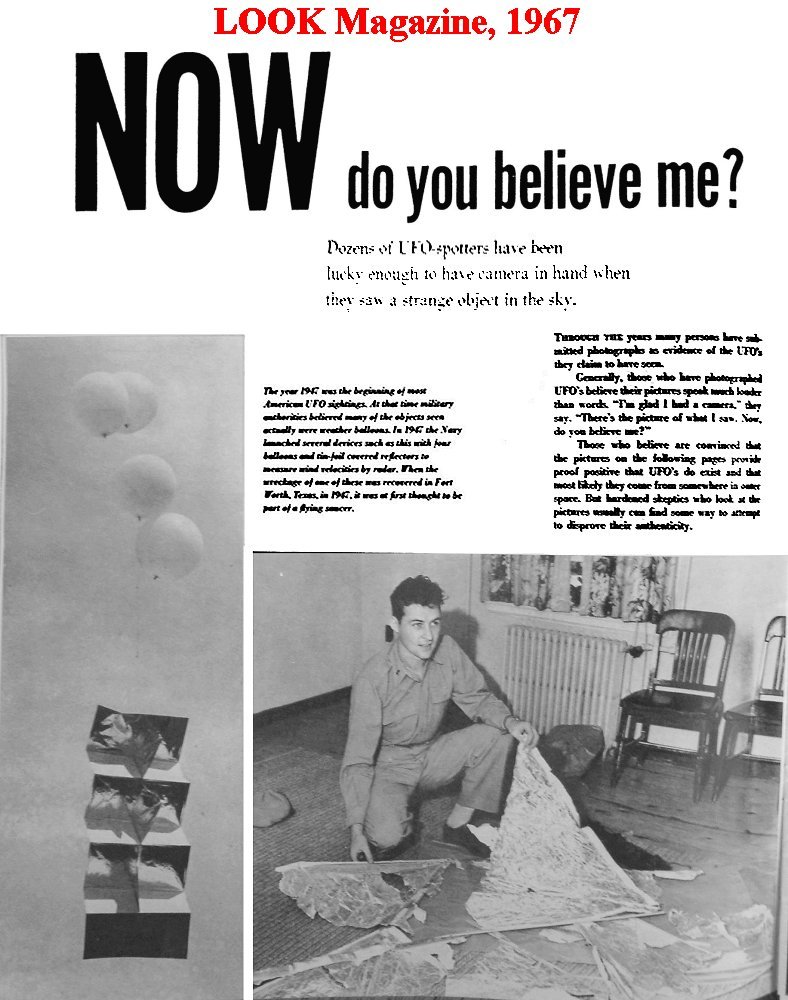
In 1967, LOOK Magazine carried a special insert on flying saucers. Included was a photo from July 8, 1947, of Gen. Ramey's weather officer posed with the wreckage of a weather balloon and radar target in Ramey's office, supposedly the debris recovered from Roswell. Like many post-1947 writeups on Roswell, there were a number of factual mistakes, such as the weather balloon being recovered near Fort Worth and being from the Navy instead of Army.
Caption:
"The year 1947 was the beginning of most American
UFO sightings. At that time military authorities believed
that many of the objects seen actually were weather
balloons. In 1947, the Navy launched several objects
such as this with four balloons and tin-foil covered
reflectors to measure wind velocities by radar. When the
wreckage of one of these was recovered in Fort Worth,
Texas, in 1947, it was at first thought to be part of a
flying saucer."

1967
By Ted Bloecher
Ted Bloecher’s monumental review of 1947 flying saucer sightings, based on review of nearly 200 newspapers, gave a detailed account of Roswell. However, Bloecher wrote off the case as “an embarrassingly obvious mistake” and the result of “a series of clumsy blunders in public relations”, and the base press release saying they recovered a disc a “reckless statement.” Also Bloecher does some mind-reading, claiming the press was allegedly desirous of a “crashed disc” and eagerly blew up the story out of all proportion. (What else were they supposed to do with an OFFICIAL press release that the Army had recovered a flying disc?) Nevertheless, Bloecher's dismissive attitude towards Roswell and other crashed saucer stories was probably typical of most Ufologists then, and to some extent even now.
Bloecher also made several bad factual mistakes, which is odd if he relied exclusively on newspaper stories. It was almost as if Bloecher also used a little artistic license in writing up the case in order to ridicule it (therefore ironically guilty of the same exaggerated reporting he accuses the press of engaging in back then.) E.g., rancher Brazel did NOT report what he found after “hearing news broadcasts of flying saucer broadcasts.” (He had no electricity, much less a radio—the papers and later witnesses actually say he heard about the saucers when he went to Corona or after speaking with neighbors.) And Bloecher erroneously claimed a “search party” was sent out to the ranch AFTER the press reports and then delivered the “collected remains” to Fort Worth to be identified by Gen. Ramey as a weather device. No newspaper ever reported such thing. Instead, Gen. Ramey QUICKLY identified and debunked the Roswell saucer as a balloon. Therefore the ID had nothing to do with a “search party” being sent out AFTER the base announcement. Instead, the “search party” was sent out BEFORE and collected debris, which led to the base press release. Bloecher has the events backwards.
Bloecher’s writeup:
“Hoaxes and Mistakes
“While newspapers still carried a few apparently genuine UFO reports -- often buried among a mish-mash of superficial nonsense -- the kind of stories that made headlines after July 8th were the sort a reader found impossible to take seriously. If a report wasn’t an out-and-out hoax, it was an embarrassingly obvious mistake. One of those mistakes, given the widest possible publicity, had its origins near Roswell, New Mexico, when a farmer named William W. (‘Mac’) Brazel discovered the wreckage of a disc on his ranch near Corona, early in July. After hearing news broadcasts of flying saucer reports, Brazel, who had stored pieces of the disc in a barn, notified the Sheriff's Office in Roswell, who, in turn, notified Major Jesse A. Marcel, of the Roswell Army Air Field intelligence office. The remnants of the disc were taken to Roswell Field for examination. Through a series of clumsy blunders in public relations, and a desire by the press to manufacture a crashed disc if none would obligingly crash of itself, the story got blown up out of all proportions that read ‘Crashed Disc Found in New Mexico.’
“According to AP on July 8th, public information officer Lt. Walter Haught made an announcement of the discovery: ‘The many rumors regarding the flying disc became a reality yesterday when the intelligence office of the 509th Bomb Group of the Eighth Air Force, Roswell Army Air Field, was fortunate enough to gain possession of a disc through the cooperation of one of the local ranchers and the sheriffs office of Chavez County.’ The effect of this reckless statement was equal to an atomic detonation; results were immediate. While newspaper deluged the air base for additional information, a search party was sent out to scour the landing site for additional fragments; the collected remains of whatever it was that had crashed on Brazel’s ranch were taken to Eighth Air Force headquarters in Fort Worth, Texas. There, Brigadier General Roger M. Ramey tried to clarify matters by first explaining that no one had actually seen the object in the air; that the remains were of a flimsy construction; that it was partially composed of tinfoil; and, finally, that it was the wreckage of ‘a high altitude weather device.’ Warrant Office Irving Newton, a weather forecaster at the Fort Worth Weather Station, had identified the crashed ‘disc’ as the remains of weather equipment used widely by weather stations around the country when sending balloons aloft to measure wind directions and velocity. There remains the possibility that some super-secret upper-atmospheric balloon experiment had crashed near Corona, which would have accounted for all the confusion and secrecy involved in its recovery.
“Whether the pictured balloon equipment carried widely in the press was actually a photograph of the recovered fragments remained a question, but news editors should have been on their toes: other similar incidents had already been reported, like the discovery several days before of the weather device at Circleville, Ohio. The New Mexico incident created an uproar in Washington, and high Army Air Force officials were reported to have delivered a blistering rebuke to Roswell Field spokesmen for having fostered the confusion. But the damage had already been done and the next day ‘Another Saucer Shot Down’ was typical of the headlines found in American papers.”
The Search for Life on Other Worlds" (1967) (New: Added April 2024)
USN captain David Holmes
In this book on astrobiology and space exploration, author Holmes brings up the subject of small, preserved humanoid aliens at Wright-Patterson AFB from a rumored "southwest" crash of a space craft. It is unclear if Holmes is actually referencing Roswell, but he seems to be well aware of the rumors of such crashes plus the remains being stored at W-P AFB. He was also knowledgeable on the subject of UFOs and thought them an enigma requiring further investigation.
(p. 12) "Perhaps they will even quote the rumor that somewhere in Wright-Patterson Air Force
Base there are hidden away the embalmed bodies of several small humanoid figures who were
allegedly pulled from the wreckage of a space craft which crashed in the south West a few
years ago"
July 10, 1972
Sheboygan WI Press, p. 22
(found on ancestry.com)
25 YEARS AGO TODAY—JULY 10, 1947
The paper got the day wrong by 2 days, but otherwise culled this 25 year anniversary news item from the early newspaper reports of July 8 that a flying disc had been found near Roswell:
“Roswell, New Mexico—The army air force here today announced a flying disc has been found
on a ranch near Roswell and it is in the army’s possession. America’s ‘flying saucer’ jag reeled
on today. Stiff necks and goggle eyes were the order of the day; skywatching was a new
profession.”
Winter 1974
Saga Magazine
“UFO Report” by Peter Gutilla, p. 60 (source)
While researching a UFO article for Saga in 1973, correspondent Gutilla ran into the son of Lydia Sleppy, who mentioned his mother had an incredible UFO story she had been telling for many years to friends and family, which turned out to be about Roswell. Lydia Sleppy’s story of her teletype about the Roswell saucer crash being cut off by the FBI is now well-known and she is often considered to be the first modern Roswell crash witness. Gutilla, however, didn’t mention her name or the FBI or use the word Roswell. The story was largely overlooked at the time, except by researcher Stanton Friedman, who eventually did revive the Roswell case in 1978:
"In New Mexico a woman with a responsible position received a call from a station manager.
He had been checking out reports of a UFO which had crashed in a field and was trying to
track down the rumor that pieces of the object were supposedly stored in a local barn. In his
excited call to the newsroom, the station manager verified the UFO crash report, and also
claimed to have seen metallic pieces of the UFO being carried away to a waiting Air Force
plane destined to Wright Patterson Air Force Base. As the woman was typing the fantastic
news item over the teletype to their other two stations, a line appeared in the middle of her
text, tapped in from somewhere, with the official order, 'Do not continue this transmission!'"
October 1974
News conference and radio interviews with Prof. Robert Spencer Carr
Here’s another early mention of N.M. crashed saucers that might be loosely based on rumors of the Roswell crash.
Robert Spencer Carr had been a science fiction writer and professor of mass communications at South Florida University. He had also been a special advisor to NICAP, a Director of Educational Research for Walt Disney Studios, and served with the Army Orientation Service, producing educational films for the State Department.
Carr basically resurrected Frank Scully’s Aztec saucer crash of February 1948, claiming different sources than Scully. Carr was also perhaps the first person to publicly speak seriously about autopsies being conducted on alien bodies, which he originally claimed were perfectly formed, small humans three to four feet tall, that apparently were genetic cousins to us. Carr said the Aztec/Farmington saucer was intact, 31 feet in diameter (vs. Scully's 99 feet, or 31 meters) and had 12 bodies inside (Scully 16). The crew had died of sudden decompression, from a small hole in the dome, which was ultimately the cause of the craft landing/crashing. Carr said the landing was tracked by three radar stations, as opposed to Scully or the 1950 FBI memo saying the crash was the result of radar interference from three such stations.
Carr said nothing about Roswell, but did speak of a second, N.M. crashed saucer, allegedly found two weeks later and 200 miles south. It was an “old wreck”, half-burned, and with charred, mummified, and decayed bodies on the inside. If you ignore the later 1948 date and substitute 200 miles southeast for south, this would be in the vicinity of the Roswell crash site(s) and debris field near Corona and Roswell. So just perhaps this part of Carr’s story harkens back to rumors of the Roswell crash.
Carr in original interviews would mention three sources “a high ranking Air Force Officer, who he says was aboard the cargo plane that brought the craft back from Edwards Air Force Base [to Wright-Patterson] ....A security guard at Wright Patt...and third, a biologist.” The biologist, who regularly vacationed during Winter in Florida, allegedly showed Carr the biological section of the general report of the crash.
Carr at one point let slip that the name of the alleged W-P security guard was Arthur Bray. Bray, a Canadian, when contacted said he never worked at W-P and was not a source of Carr’s story. Bray said the Aztec crash was “old news,” that he was familiar with the story since reading the Frank Scully book in 1951. What’s ironic about this, is the same Arthur Bray in 1978 uncovered the Wilbert Smith Canadian papers from 1950-1951, discussed above, basically stating, from an official briefing Smith received in Washington D.C., right after Scully’s book came out in 1950, that the information in the book about there being crashed saucers was "essentially correct." (First described in Bray’s 1979 book, “The UFO Connection”) Bray had been researching UFOs since the Roswell period of 1947 and had previously published a book on UFOs in 1967, “UFOs—Science, the Public, And The UFO.” After that he began lobbying the Canadian government and the United Nations to undertake scientific studies of UFOs.
Leonard Stringfield, in his first crash retrieval report from 1978 (see below), wrote of knowing Carr since the 1950s, thinking his statements in letters to him to be "well-written, factual, and conservative." Stringfield called him March 28 and 31, 1978, to discuss his information on the Aztec case. Carr said he had been working the case for 17 years and now had 5 witnesses who he said gave him extensive information, again a high-ranking AF officer stationed at W-P and a W-P guard plus a "surgical nurse", and added two aeronautical engineers. The "biologist" from 1974 was not mentioned. Carr either did not reveal the names to Stringfield, or asked him not to use them in his report.
Again Carr repeated the story of the craft being tracked by three radar,12 humanoids being recovered, and death being caused by explosive decompression from a small hole in a porthole. One significant difference in Carr's story was his description of the aliens, which instead of now being small humans were now more like the typical description of the "Grays". Allegedly Carr's witnesses all described the bodies "from 3 to 4 feet tall, with elongated heads, oversized compared to their bodies; and, with eyes slanted, looking oriental. The clothing worn by each member was tight-fitting and without insignia."
Interestingly, when Carr first began publicly speaking about this in 1974, I heard his story on Monitor Radio News while driving through Arizona with my wife. I had read vague rumors about crashed saucers before this (such as Frank Edward’s book), but both my wife and I were shocked to hear such a story on a news program. The part of the news item that really stuck in my mind (besides the part about the beings being perfect little men) was Carr’s claim that when the doctors examined the brain in the first autopsy, they gasped because it was so highly convoluted, from which they deduced the being must have been hundreds of years old.
In 1994, I spoke by phone with Stringfield, shortly before Stringfield died of lung cancer. I told Stringfield about hearing the story on the radio 20 years before and wondered who the source was. Stringfield told me it was Carr, and said his information was that the story was carried only in limited areas, perhaps as a test to see how people responded.
Carr’s son, Timothy, would later claim, after his father’s death, that his father was a spinner of preposterous tall tales that he would tell in front of strangers to gain attention, would steadfastly insist that they were true, and mortify both he and his mother in the process. If we take Timothy Carr’s statements at face value, it is quite possible that his father did obtain information from well-informed sources like Bray, but then exaggerated what he was told.
However, at the same time as Carr’s statements on a radio interview, but independent of him (see above links) was another source speaking of a crashed saucer and recovered alien bodies at Wright-Patterson, this time from the end of the 1960’s. John Getter, a television reporter for AVCO Broadcasting in Cincinnati, related that 3 years before a personal friend told him she had helped classify a flying saucer and several dead crewmen while serving as the executive secretary to the officer in charge of security at W-P. But when Getter asked her to repeat her story for the radio program, she refused.
The radio transcript goes on to say that Getter added,
“‘She has been told, she says, that if she even discusses matters which came across her desk when
she was in the employ of the Air Force that she could lose .... her pension and so on and so forth,
and after that they could end up prosecuting her.’ When Getter asked if she could tell him if they
were on the right track, she said she couldn't even confirm that, however ‘I remember her words,
here she said, I can't really say but, I would be very interested to know what you find out from
other people.’ When pressed further about the conversation, Getter said that he felt from the tone
in her voice that the investigation was on the right track, but she is afraid to say so for fear of
retaliation for breaking the silence.”
Again there is nothing here specifically about Roswell, but does again make the point that stories of crashed saucers and alien bodies at Wright Patterson were circulating well before the Roswell case was reopened. Stringfield had many more from the 1970s, discussed more below.
1976, UFO Casebook, by Kevin Randle (but not published until 1989), pp. 124-127; 234
Although not published until 1989, the incident and researcher Kevin Randle’s notes date to 1976. While researching trace landing cases in the Midwest, Randle spoke to an Air Force sergeant. The sergeant told him he was part of team, following orders from the Pentagon, that brought in shill balloons and faked balloon flights, similar to the Skyhooks, to cover up prominent UFO sightings. However, the only time he personally did so was when he was sent into Roswell with a phony balloon explanation. The unit was then sworn to secrecy.
The balloons required perfect weather conditions for launch and were tracked until they came down. They knew where they were at all times, therefore he knew that their staged “solutions” had nothing to do with the sightings. Many other UFO sightings were also later falsely explained away by bringing in the balloons. According to researcher Anthony Bragalia, the unnamed sergeant also said, “The wreckage contained the silvery elements of the rawin radar reflectors, the neoprene balloon envelope, and the balsa sticks that had formed the frame of the reflector."
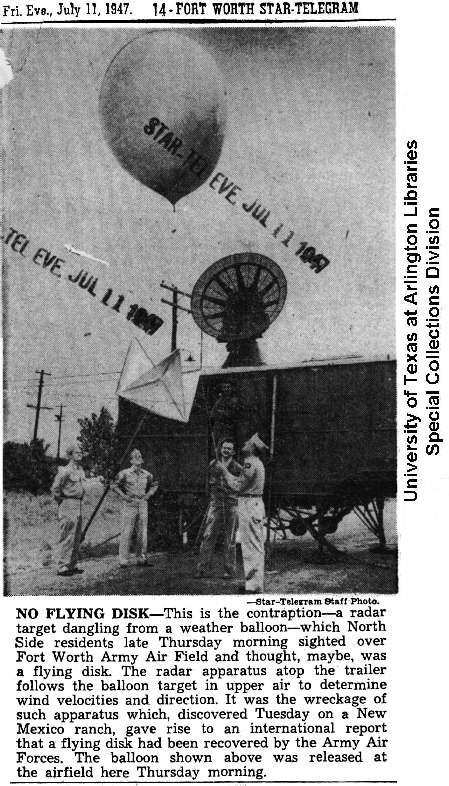
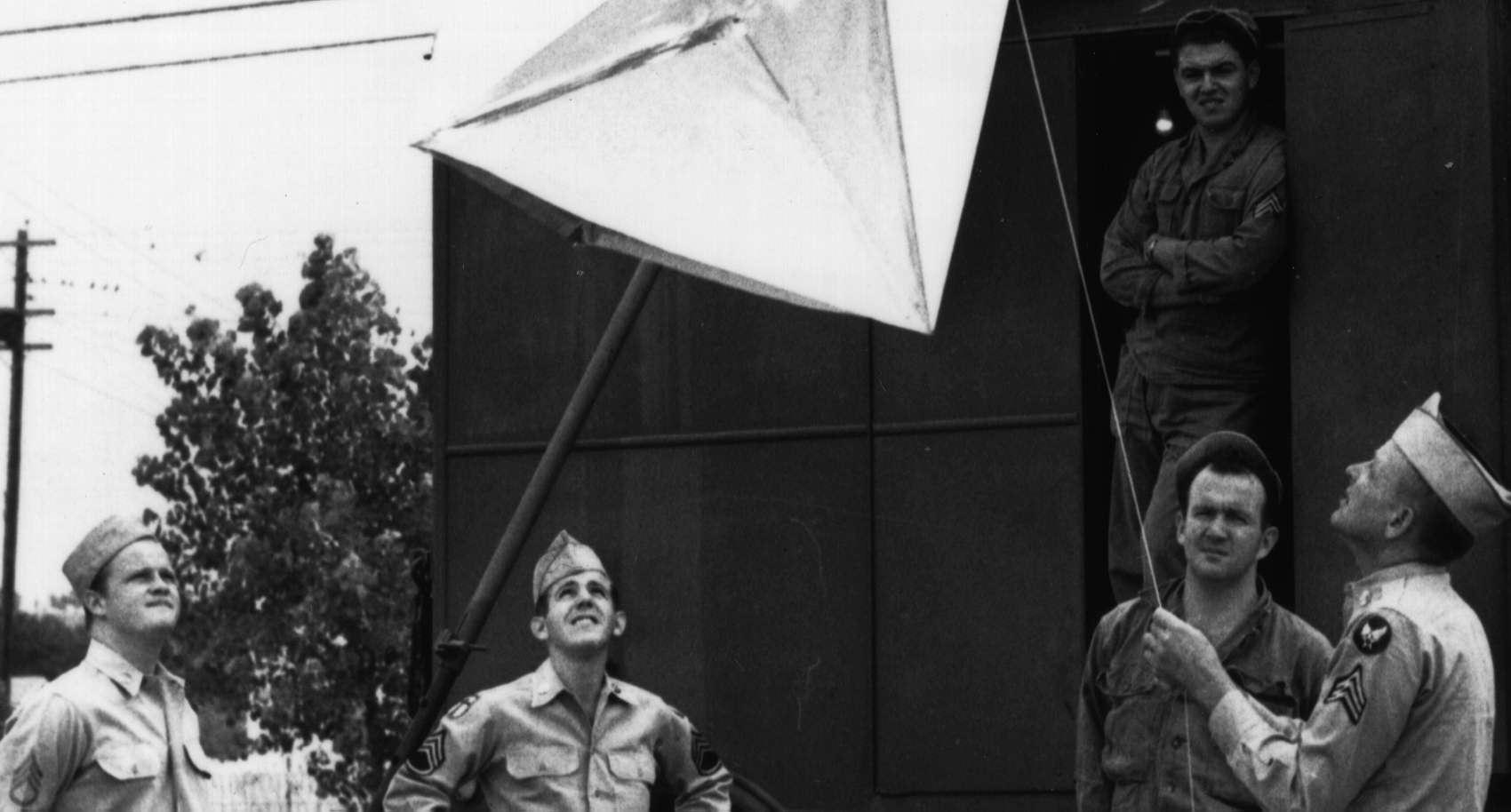
This was the same material displayed by General Ramey in Fort Worth on July 8, 1947, to explain away the Roswell “flying disc.” There was also a demonstration two days later (July 10) at Fort Worth by a five-man balloon launch team of the rawin radar target hoisted by a weather balloon. (photo right top) And there was another at Alamogordo on July 9 involving a team. I am unaware of any similar balloon demonstrations in Roswell at that time.
Randle said he had never heard of Roswell when told the story and it was only later he understood the significance of what he had been told. As a result, it may be the story got a little mixed up. Perhaps the sergeant meant they staged balloon demos at Alamogordo and/or Fort Worth to deflect attention away from Roswell. Negatives of the Fort Worth demo still exist, and three of the men pictured are indeed sergeants, as shown in the enlargement at right. Perhaps one of them is the one who spoke to Randle. The tall one at the far right also seems to resemble at least one of the long-legged men shown in the Alamogordo demonstration at the top of this article.
January 1977
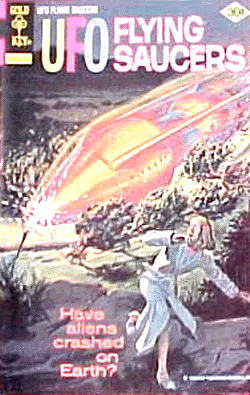
UFO Flying Saucers comic book
"Have aliens crashed on Earth?"
Again, nothing specific about Roswell, but again an illustration of crashed saucer rumors pre-Roswell revival in 1978.
(From Grant Cameron's website)
June 22, 1977
Chicago Tribune, p. A1
“UFO research and journals are getting down to Earth”, by Paul Weingarten
(found on Google Books and Proquest historical newspapers)
Paul Weingarten still writes for the Tribune and is on the editorial board. He told me in an email he doesn't remember where he got the story about Roswell. This article was apparently prepared for the 30th anniversary of the June 24, 1947, Kenneth Arnold sighting, that got the whole “flying saucer” phenomenon going in modern times. According to the story, Arnold was in Chicago as keynote speaker for the International UFO Congress. The article also goes into Ufology starting to use more scientific methodology and gaining a measure of respectability with the public and in the scientific community, since the debunking of the Condon Commission back in 1969. The Tribune also published a follow-up article 3 days later mentioning some of the scientists involved in Ufological research, also speaking at the conference.
First the article recapped Arnold’s sighting and origins of the term “flying saucer.” The article then goes on to confuse the “ghost rocket” sightings of the previous year with the sightings immediately following Arnold’s, before finally getting to Roswell, also in a slightly confused way. Again the name “Roswell” isn’t specifically mentioned here:
“That was all it took [report of Arnold sighting]. Within days, thousands of Americans reported
seeing glowing disks in the sky. …’The Great Saucer Mystery Deepens,’ the headlines screamed
as the nation plunged into saucermania. And it wasn’t just the United States. ‘Ghost rockets’ lit
the skies over northern Finland. Swedes spotted great ‘balls of fire’ in the skies—500 of them in
26 days. Portuguese gazed at strange ‘bluish missiles’ in their sky at dawn. Military,
government, and academic officials tried to explain the phenomena away as large ice nuclei,
meteorites, static electricity, or just plain ‘mass hysteria.’
“It didn’t work. ‘Platter panic’ exploded a few days later when an Army press agent mistook
remnants of a weather balloon for a saucer, and announced that a flying disk had been found on
a New Mexico ranch and was in Army possession. Newspapers were deluged with telephone calls.
Army officials scrambled to the site. Things calmed down when they discovered the mistake, but
flying saucers were here to stay. ”
The brief recap blames it all on the bungling of the “press agent” (as Associated Press reported in 1947). There is no mention here of an official Army press release put out by the base commander, Col. William Blanchard (as reported by United Press back at the time). In modern times, the “press agent,” Walter Haut, has always maintained that it was Blanchard’s authorized press release, dictated by Blanchard, and also had a few very interesting things to say before he died, namely it was a real flying saucer crash and Col. Blanchard took him to see a craft and bodies in a hangar. (See Walter Haut page)
And as in Bloecher’s bungled account directly above, there was also no time for “Army officials” to “scramble to the site” to find out what had really happened. Instead, the press release was debunked as a weather balloon, starting within an hour, over at higher command in Fort Worth, with debunking photos of a balloon taken. As in other accounts above, the reporter got things a little mixed up.
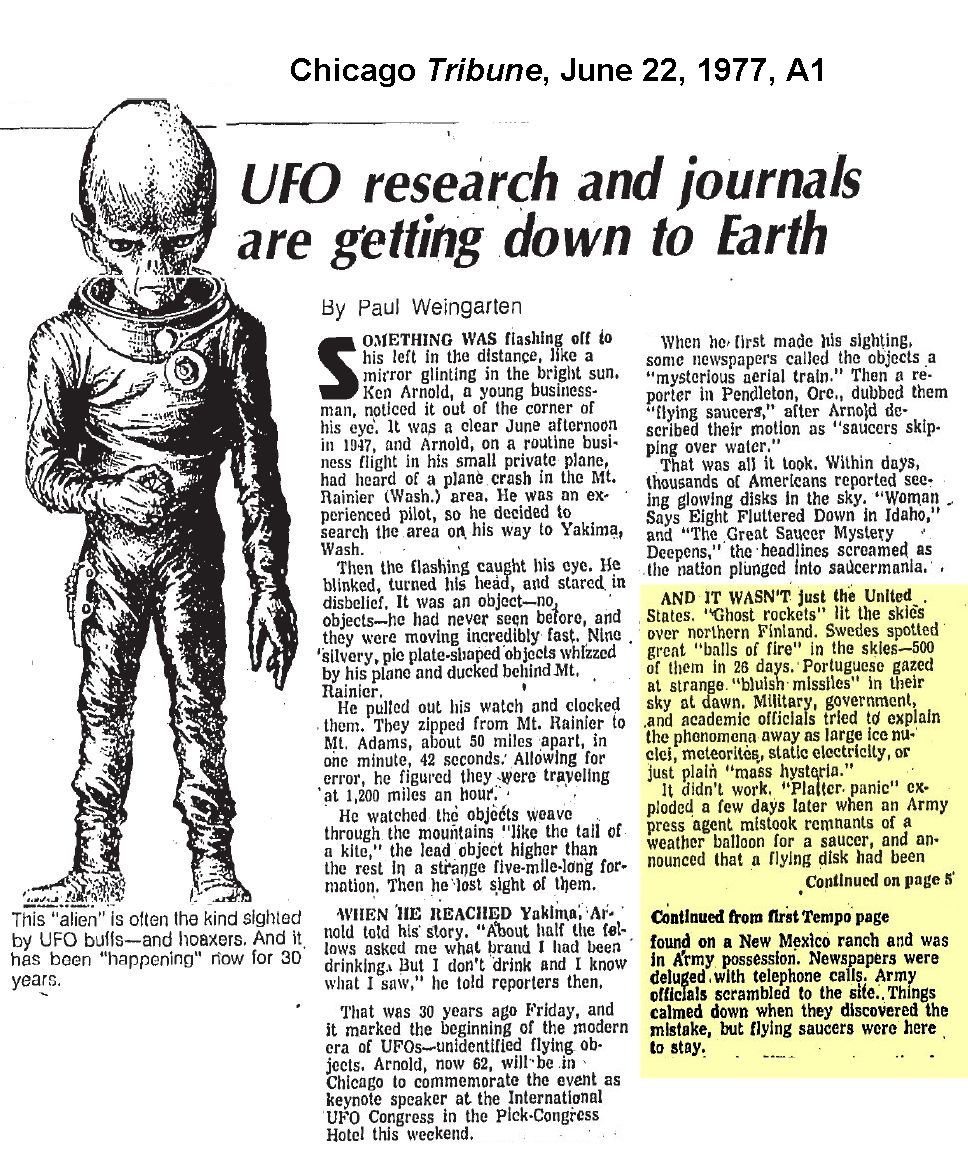
The article is also interesting for having a drawing (above) of a small alien being with this description:
“This ‘alien’ is often the kind sighted by UFO buffs—and hoaxers. And it has been “happening”
now for 30 years.”
The drawing shows the classic disproportionately large, bald, pear-shaped head with pointy chin, somewhat enlarged eyes, nostrils but absence of nose, slit mouth, and elongated arms. (However, drawing also has non-classic large pointy ears and thumbs.) This was a year before the Roswell case was reopened by researchers and reports of the small alien bodies with large heads that continued to emerge over the next 30 years. But as shown immediately below, there were many such alien descriptions already being collected by Ufologist Leonard Stringfield from a variety of sources.
And finally, the article is interesting for it’s quotes of what Kenneth Arnold was thinking 30 years later. Arnold said he wasn’t surprised that flying saucers were still being seen. He knew at the time that they were something that was here to stay.
Oct. 7, 1977
Bob Pratt had been a straight-arrow mainstream newspaper reporter and editor, but then became the UFO reporter for the tabloid National Enquirer newspaper. Nevertheless, he remained well-respected for his sober, detailed, and factual reporting of UFO cases all over the world.
In 1977, before he even knew of Roswell, Pratt was hot on the trail of General Roger Ramey, who we all know now was the general who killed the Roswell story of the recovered flying disc as a weather balloon. On July 29, 1952, Ramey, now A.F. Operations Officer, was one of the key people at a large press conference in Washington D.C., designed to calm down national panic and debunk recent headline stories of UFO radar and visual sightings over the nation's capitol. (See Ramey and UFOs) At the time, he was called one of the A.F.'s top two UFO experts and their "saucer man." On the same note, Brig. Gen. Arthur Exon, former C/O of Wright-Patterson, would later tell researchers that not only was Roswell the crash of a spacecraft and covered up, but Ramey was one of the high Pentagon generals he ran into in the 1950s secretly looking into the UFO problem, a cabal he nicknamed the "Unholy 13". (See Exon page)
Donald Keyhoe, who headed NICAP and published many best-selling UFO books going back to 1950 (popularizing the notion of a government cover-up and the reality of extraterrestrial visitation) had attended that press conference and written about it in his books. Therefore Pratt looked him up, explaining in his interview with Keyhoe, that he had gone to the Pentagon looking for information on Ramey and was told they didn't know who he was. Pratt said he talked to Keyhoe five times from 1977 to 1979. "I was trying to learn something about an Air Force general named Ramey. Ramey’s name meant nothing to me at the time and it was only two years later when I began looking into the 1947 Roswell incident that I learned much about him."
At the time, Pratt was researching Ramey because the Enquirer had been tipped off that Ramey was an ET "believer." As Pratt explained to Keyhoe, "Somebody told one of our editors or the publisher that he was an acquaintance of Ramey’s back in the ’50s. The man who gave us this was a former brigadier general himself, I believe [speculation: Was this Brig. Gen. Exon?]. But he was under the impression that Ramey very definitely believed these (objects) were from outer space. Whether he would say that publicly, he didn’t know..."
Pratt then has a section he called, "THE PENTAGON ‘LOSES’ RAMEY". Pratt told Keyhoe, "An Air Force public affairs guy (at the Pentagon) went through his list of generals the other day and could find no reference to any such man (Ramey)... That’s curious. But he said the list was almost complete but not quite. I’m not quite sure what that meant. He had all living and dead generals but he couldn’t come across any by that name."
Keyhoe then commented, "Well, it’s possible, since you were inquiring about top figures connected with UFOs, that they may have just simply decided not to give you that information. What kind of an article, if you don’t mind, are you planning to do on this? "
Pratt responded, "Well, this came down from the publisher who said, this guy (Ramey) if you can find him, he used to believe that UFOs came from outer space. Why don’t you find him and talk to him? Well, I have to find out first what his real name is and then find out if he’s still living and, if so, where he is living, and then if he’ll talk to us about such things. So many high-ranking former officers just will not talk about UFOs, if they believe anything, you know?"
Pratt then explained he never could talk to Ramey because he had died years before (1963). I ran into the same problem Pratt did researching Ramey's background. The Air Force website with around 2000 biographies of their generals still does not list him, even though many lesser generals are listed. Ramey retired a 3-star general and had been a fairly important general in his time (he was about to became head of the Air Defense Command in 1956 when he had a severe heart attack and was forced to retire).
I was therefore forced to find information on Ramey from other sources, primarily newspaper clippings. (see, e.g., my Ramey info and Ramey & UFOs webpages) In December 2010, military biographer Charles A. Lewis emailed me to help him compile a biography on Ramey. (Lewis' Ramey biography). In the process, I asked him if it was common for a general of Ramey's stature to slip through the cracks like that, to seemingly become a nonentity. He told me it almost never happened, at least in his experience.
I guess it could be fairly argued that Pratt wasn't specifically researching Ramey's connection to Roswell. And certainly Keyhoe never raised it, either with Pratt or in any of his writings. But Ramey was so intricately tied in with the Roswell case and the UFO question, that Pratt almost stumbled onto the Roswell case in 1977, if only he had kept digging a little more. If nothing else, Pratt mentions being told that Ramey was an ET believer. Why was he a believer? And the whole bizarre thing about the "Pentagon losing Ramey" possibly suggests an attempt by the Pentagon to deflect interest in Roswell in the event any prying reporter came looking for information on one of the major players. Therefore, it could be argued this whole Ramey/Pratt/Keyhoe episode is a very indirect reference to Roswell, perhaps by deliberate omission of information on one of the key participants, also very publicly involved in the UFO question years later.
April 5, 1978
RETRIEVALS OF THE THIRD KIND: A Case Study of Alleged UFOs and Occupants in Military Custody
By Leonard H. Stringfield
Revised July 20, 1978 and presented to the MUFON Symposium July 28, 1978
Stringfield made the study of military recoveries of UFOs and alien bodies semi-respectable again when he presented this summary of such recoveries from various new sources at the MUFON symposium. As Stringfield noted about the previously anathema subject matter:
"Our collective 'scoffing was the result of an alleged grand hoax. Here, I refer to a book, Behind the
Flying Saucers by the late Frank Scully, published in 1950. Briefly, it told about a reported saucer
crash in Aztec, New Mexico in 1948. ...Investigation, however, revealed Scully's scientist was a fraud.
With the book's subsequent exposure as a hoax, which got a lot of publicity, it became unfashionable
for any object researcher to write or talk about crashed UFOs and their alleged 'little men.'
[But see Robert Spencer Carr section above, where Stringfield revised his opinion about Aztec]
"Adding fuel to the fire of a condemned book were strong Air Force denials in 1954 that a retrieved
UFO was in hiding at Wright-Patterson AFB. (see news article above) I remember calling Lt. Colonel
John O'Mara, Chief of Intelligence at the air base, inquiring about the alleged retrievals. His reply, in
part, 'Ridiculous!'
"But, despite denials and the suspicions of research, the crash and retrievals stories persisted...
[Stringfield then describes many new reliable sources emerging around 1977] We must now take a new
and honest look at the old rumors. And, we must also take a new look at the possibility of a grand
official cover up and why..."
Stringfield mentions talking by phone on April 6, 1978, with "Major J.M.", former A.F. intelligence officer, who we, of course, now know to be Jesse Marcel (Abstract 18). This was the first direct mention by Stringfield of the Roswell case. Marcel had recently been located by researcher Stan Friedman, after receiving a tip. So this was the early days in the reopening of Roswell. Marcel related how the rancher had come to town and how he and "aides" were dispatched to the area to investigate.
"There he found many metal fragments and what appeared to be 'parchment' strewn in a one
mile square area. 'The metal fragment... were unusual... because they were of great strength.
They could not be bent or broken, no matter what pressure was applied by hand.' The area was
thoroughly checked, he said, but no fresh impact depressions in the sand were found. The area
was not radioactive. The fragments, he added, were transported by military carry-all to the Air
Base in Roswell and from that point he was instructed by General Ramey to deliver the
'hardware' to Ft. Worth, to be forwarded to Wright-Patterson Field for analysis.
"When the press learned of this retrieval operation, and wanted a story, Major J. M. stated, 'To
get them off my back, I told them were were recovering a downed weather balloon.'
"When the Major was asked for his opinion as to the identification of the fragments he was
certain they were not from a balloon, aircraft or rocket. He said, because of his technical
background he was certain that the metal and 'parchment' were not a part of any military aerial
device known at that time. The retrieval of 'unusual' fragments in secrecy suggests they were a
part of an unknown aerial device or craft. Manned, or not, the Major did not know. If there
were entities aboard, no evidence was found. Had there been any bodies aboard they would have
been destroyed in what appeared to be an aerial explosion."
Stringfield also had several independent references to desert or New Mexico saucer crashes that conceivably could have something to do with Roswell, but in different years. With the exception of Aztec in 1948, the references are also all very vague. E.g.
(Abstract 1) "In the Fall of 1977, new word of a 1948 crash came to me from a well-informed military
source. His information, however, was scanty. He had heard from other 'inside' military sources that a
metallic disc had crashed somewhere in a desert region. His only details indicated that the craft had
suffered severe damage on impact and was retrieved by military units." [This Stringfield tied into other
information about an alleged Mexico crash near Texas in 1948.]
Another (Abstract 4), has a "Mr. T" relating being shown a color movie film in 1953 at Ft. Monmouth, N.J., first showing the exterior of a flying saucer being recovered by the military, then switching to interior shots, and finally three dead bodies, possibly in a tent. The description of the bodies was the usual: small with large heads...
"They looked mongoloid... with small noses, mouths and eyes that were shut. He didn't recall
seeing ears or hair. The skin, he said, was leathery and ashen in color. Each wore a tight-fitting
suit in pastel color." After the film was over, they were instructed not to discuss it but think about it.
Two weeks later, an intelligence officer told him it was a hoax and to forget about it. He also said he
heard from some top security officers on the base that the crash was in New Mexico and had been
recovered with its occupants. The date was supposed to be 1952."
Stringfield also included a composite anatomical description of a typical described alien, usually referred to now as the "Grays". This included the usual humanoid 3-1/2 to 4-1/2 feet tall, large heads, slit mouths, absence or only hint of nose and earlobes, sunken eyes with mongoloid look, absence of hair, usually tough, grayish skin, long arms down to the knees, and four fingers with no thumb. Again, this was all before the Roswell case was reopened and similar description from various Roswell witnesses emerged over the next 30 years. (e.g., see such descriptions over on Roswell mortician Glenn Dennis page and Oliver Henderson page.) Stringfield would later publish more detailed descriptions, which he said were based on medical sources.
May 1979
Second Look magazine,
“How the CIA Views the UFO Phenomenon,” by Victor Marchetti
Even though Roswell was now under active investigation and known to some UFO insiders, nothing yet had hit the major public media about what had been learned. Therefore, former CIA and NSA agent Victor Marchetti's comments in a magazine article are interesting concerning rumors within the CIA about crashed saucers and recovered small aliens. Again, Roswell wasn't specifically mentioned:
“During my years in the CIA, UFOs were not a subject of common discussion. But neither were they
treated in a disdainful or derisive manner, especially not by the agency's scientists. Instead, the topic
was rarely discussed at internal meetings. It seemed to fall into the category of ‘very sensitive
activities’...
"There were, however, rumors at high levels of the CIA—rumors of...little gray men whose ships
had crashed, or had been shot down, being kept ‘on ice’ by the Air Force at FTD (Foreign
Technology Division) at Wright- Patterson Air Force Base in Dayton, Ohio.” (more)
Marchetti also wrote a controversial insider book about the CIA in 1974, "The CIA and the Cult of Intelligence," the first book that the U.S. government ever went to court before publication to have censored. In the end it was heavily censored because Marchetti went into great detail on CIA covert operations. In 1975, Marchetti's book in part led to a Senate Intelligence Committee investigation, headed by Sen. Frank Church, into illegal CIA covert operations. Among the revelations was the CIA illegally had at least 400 U.S. journalists on their payroll, meaning they could slant domestic news any way they wanted. I consider this revelation very relevant to how the UFO question was and maybe still is managed in the press, even though the Church Committee investigation allegedly led to the banning of the practice.
The Flying Saucer Story, Brinsley LePour Trench, 1966
In 1966 Brinsley LePour Trench repeated the Hughie Green story in his best-seller "The Flying Saucer Story". He said it had, "crashed in New Mexico and that the Army had moved in to investigate." Again Roswell wasn't specifically mentioned.
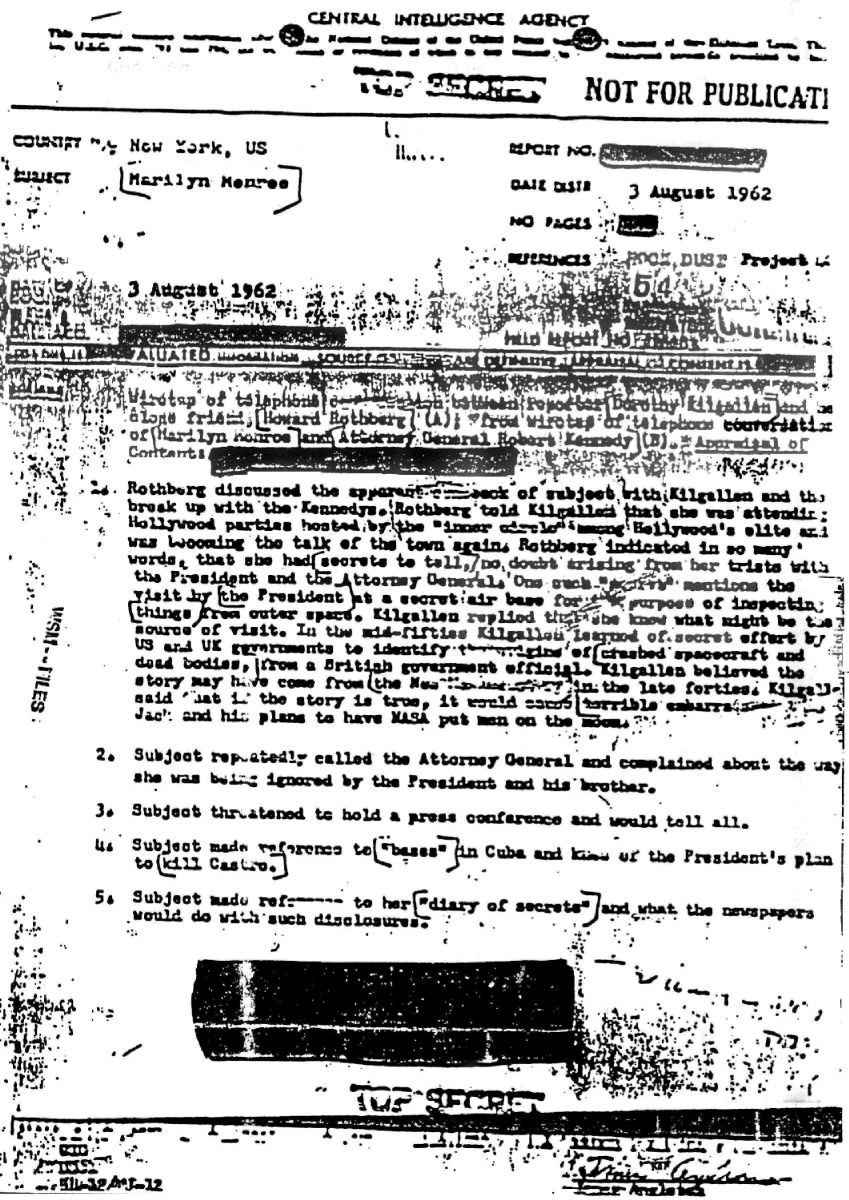
August 3, 1962, alleged CIA document about wiretaps on columnist Dorothy Kilgallen and Marilyn Monroe about what Monroe knew about crashed saucers
This extraordinary Top Secret CIA document, if authentic (a BIG "if"), concerns a wiretap ordered by Attorney General Robert Kennedy on society columnist Dorothy Killgallen but also a wiretap on phone conversations between Kennedy and Monroe. Both Robert and President John Kennedy had been having an affair with Monroe and allegedly spilling State secrets to her, including crashed saucers. The well-connected Kilgallen had been writing about the reality of the saucers and crashed saucers since 1954-1955. Monroe allegedly claimed that Pres. Kennedy had been taken to a secret base "for the purpose of inspecting things from space... Kilgallen believed the story may have come from the New Mexico story in the late forties." This would likely be a direct reference to the Roswell crash news stories of 1947 or possibly the Aztec crash story of Frank Scully that he started writing about in late 1949 (above).
"Wiretape of telephone conversation between reporter Dorothy Kilgallen and her close friend, Howard Rothberg (A); from wiretap of telephone conversation of Marilyn Monroe and Attorney General Robert Kennedy (B). Appraisal of Content:
"1. ... Rothberg indicated in so many words, that she had secrets to tell, no doubt arising from her trists [sic] with the President and the Attorney General. One such "secret" mentions the visit by the President at a secret air base for the purpose of inspecting things from outer space. Kilgallen replied that she knew what might be the source of visit. In the mid-fifties Kilgallen learned of secret effort by US and UK governments to identify the origins of crashed spacecraft and dead bodies, from a British government official. Kilgallen believed the story may have come from the New Mexico story in the late forties. Kilgallen said that if the story is true, it would cause terrible embarrassment for Jack and his plans to have NASA put men on the moon.
"2. Subject repeatedly called the Attorney General and complained about the way she was being ignored by the President and his brother.
"3. Subject threatened to hold a press conference and would tell all..."
The memo was signed by the infamous spymaster James Angleton, who was then CIA Chief of Counterintelligence. Two days later, Monroe was dead, allegedly a suicide from a massive overdose of sleeping pills. Kilgallen was similarly to die three years later of an overdose of sleeping pills and alcohol. Her death has likewise been widely speculated as being murder, since she had told friends she was about to break open the Kennedy assassination case.
The memo first came to light in in the early 1990s under questionable circumstances. Researcher Dr. Donald Burleson of Roswell filed a FOIA request for transcripts of the phone taps. The CIA turned down the request. When Burleson filed an appeal, the CIA accepted the appeal, which was a tacit admission the document was in fact real, otherwise they could have easily rejected the appeal on the grounds that the document mentioning the phone taps was phony. But there has never been an explicit admission the document was genuine. Burleson would later write a book on the subject: UFOs and the Murder of Marilyn Monroe.
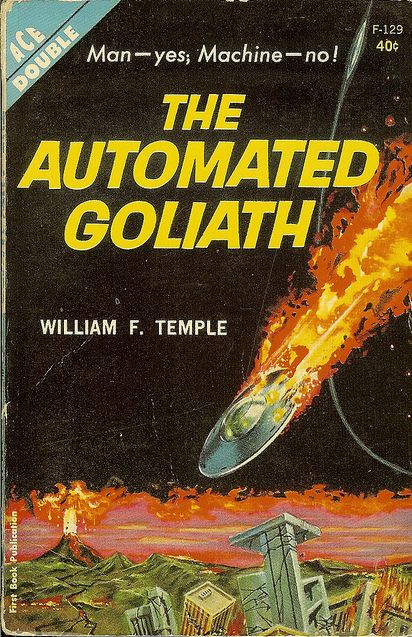
The Automated Goliath, William F. Temple, 1963
The cover by Sci-Fi artist Ed Emshwiller shows another crashing flying saucer. The story is about how hostile aliens planned to use a future Earth's highly automated and machine-run infrastructure to take over the planet. Author William F. Temple was a member of the British Interplanetary Society (BIS), which had been promoting space travel since 1933. Other than an obvious interest in the subject matter, it is unclear whether either man believed in aliens visiting earth or were in any way necessarily thinking about Roswell. However, it does illustrate the concept of crashed saucers continuing in popular sci-fi culture, much like the sci-fi cover illustrations previously mentioned by artist Virgil Finlay. It is interesting that Temple was once a roommate of famed author Arthur C. Clarke, and Clarke was definitely aware of Frank Scully 1950 crashed saucer book, mentioning it in the BIS Bulletin (edited by Temple) in a review article ridiculing saucer contactee George Adamski's 1953 book.."Flying Saucers Have Landed". The only point here is that crashed saucers probably would have been familiar to Temple as well, even if just from Scully's book.
The Search for Life on Other Worlds, USN captain David C. Holmes, 1967
A book about astrobiology and space exploration, on page 12, says:
"Perhaps they will even quote the rumor that somewhere in Wright-Patterson Air Force Base there are hidden away the embalmed bodies of several small humanoid figures who were allegedly pulled from the wreckage of a space craft which crashed in the South West a few years ago".
Although again nonspecific, the statement was likely inspired by either Scully's book or Roswell. If nothing else, it showed that rumors about small humanoid alien bodies from crashed space craft continued to circulate.

